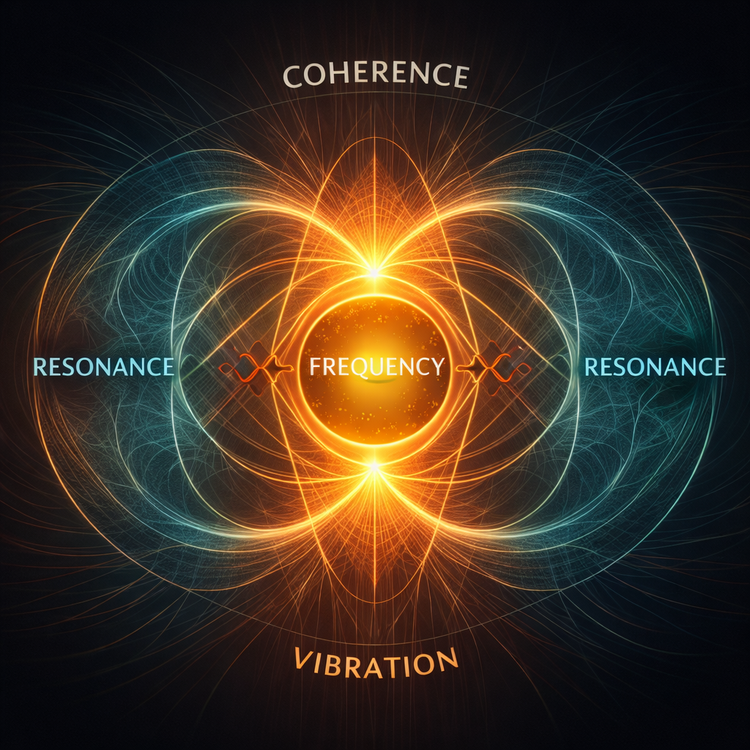

What is coherence?

◐ Human Access
Coherence is what it feels like when you stop fighting yourself.
It’s the quiet sense that your thoughts, emotions, body, and actions are all pointing in roughly the same direction.
You don’t feel “perfect.”
You feel settled.
You notice coherence when:
- decisions stop taking so much energy,
- you no longer need to rehearse explanations,
- your body feels like it’s on your side again,
- life feels simpler, even when it’s still demanding.
Coherence is the relief of not being split inside.
When coherence is present, you trust yourself more.
When it’s missing, even small choices feel heavy.
This isn’t weakness.
It’s a signal.
— pause —
How Coherence Shows Up in Daily Life
You may recognize coherence through:
- fewer inner arguments,
- less urgency to justify yourself,
- clearer yeses and cleaner noes,
- more consistent energy across the day,
- faster recovery after stress.
Incoherence often feels like:
- saying yes when your body says no,
- knowing what’s true but not acting on it,
- feeling busy but not effective,
- carrying a low-level tension that never quite leaves.
These aren’t character flaws.
They’re indicators of misalignment.
— pause —
Gently Improving Coherence
Not by tightening control — by removing contradiction.
- Say fewer things you don’t mean.
- Make smaller promises and keep them.
- Slow down until your body can agree with your mind.
- Close loops instead of opening new ones.
- Let discomfort inform you instead of override you.
Coherence grows when you stop negotiating against yourself.
◼ Structural Edge
Coherence is the ability of a system to hold its shape without leaking energy.
It describes the degree of alignment between intention, thought, emotion, and action.
A coherent system:
- wastes less energy,
- stabilizes more easily,
- transmits information with less noise,
- and recovers faster from disruption.
Coherence answers the question:
“How stable is this system?”
— pause —
What Coherence Is Not
- Not emotional suppression
- Not constant calm or control
- Not rigidity or sameness
- Not spiritual bypassing
- Not perfection
Coherence ≠ being unbothered.
Coherence = being aligned.
A system can be intense and coherent.
It can be gentle and incoherent.
Intensity and coherence are independent variables.
— pause —
At a Glance
| Term | Structural Meaning | Human Sense |
|---|---|---|
| Coherence | Stability of alignment | “I’m not fighting myself” |
| Frequency | Identity of the system | “The tone I live from” |
| Vibration | Activity of energy | “How much movement I feel” |
| Resonance | Compatibility between systems | “This fits / this doesn’t” |
Why Coherence Matters
Coherence is what makes growth sustainable.
Without coherence:
- insight overwhelms the system,
- change collapses under pressure,
- resonance becomes unstable,
- and frequency fluctuates wildly.
With coherence:
- progress integrates,
- relationships stabilize,
- and complexity becomes manageable.
Coherence is the infrastructure of change.
One-Sentence Lexicon Tag
Coherence is the ability to hold alignment over time — felt as inner agreement, defined as structural stability.
If you felt a sense of exhale while reading this,
that’s coherence recognising itself.